
Share This:
How many times have you heard someone say, “I’m just not a good speller”? Maybe you’ve even said it about yourself. Somewhere along the way, we decided that spelling is a talent. You either have it or you don’t. And once we get students to encoding multisyllabic words, the divide between the “good” spellers and the “poor” spellers becomes more apparent.
I’m an eternal optimist, and I don’t buy that. I don’t think anyone is doomed to be a terrible speller. What I do think is that many students simply have not been taught the kinds of strategies or, more likely, have not been given the amount of practice that makes advanced spelling make sense. With a simple routine and a few different instructional strategies like the 3 Great Spelling Rules and knowing every syllable must have a written vowel, we can give all students the best possible chance at becoming a proficient speller of multisyllabic words.
One thing I consistently see missing from core reading programs and most word study programs is cumulative review. There is often strong, explicit instruction in a specific skill, but once that skill is taught, it is rarely revisited. If we want students to become proficient, we cannot limit practice to the skill of the week. We have to intentionally weave in skills students have already learned (called interleaving).

The easiest way I know to do this is through daily dictation. If you already have a word study block built into your day, this is the perfect place to incorporate dictation. Dictation simply means saying a word or a sentence aloud and asking students to write it down. It provides structured, focused spelling practice that is separate from the writing block. Once we hit 3rd grade, our dictation must be working with multisyllabic words. We simply cannot stay in single-syllable words forever.
I use half-sized composition books for dictation because they are the perfect size for a day’s work and help keep all spelling practice in one place. I do occasionally use dry erase boards, but I always make sure students are also spelling on paper. I want them to be successful in the mediums in which they are expect to perform.
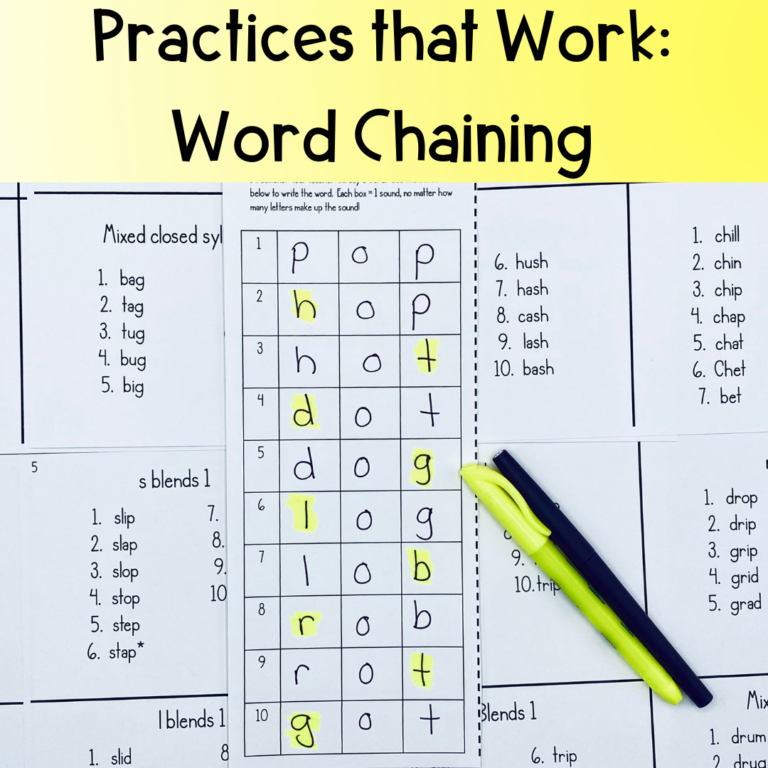
After we write our ABCs (yes, even in upper elementary), I have students write the numbers 1 through 5 down the side of the page. There is no magic to the number five and no specific research behind it. It is simply what I can fit into a short amount of time. More words would certainly provide additional practice, but we work within the time we are given. I typically give students 4 words and 1 dictated sentence.
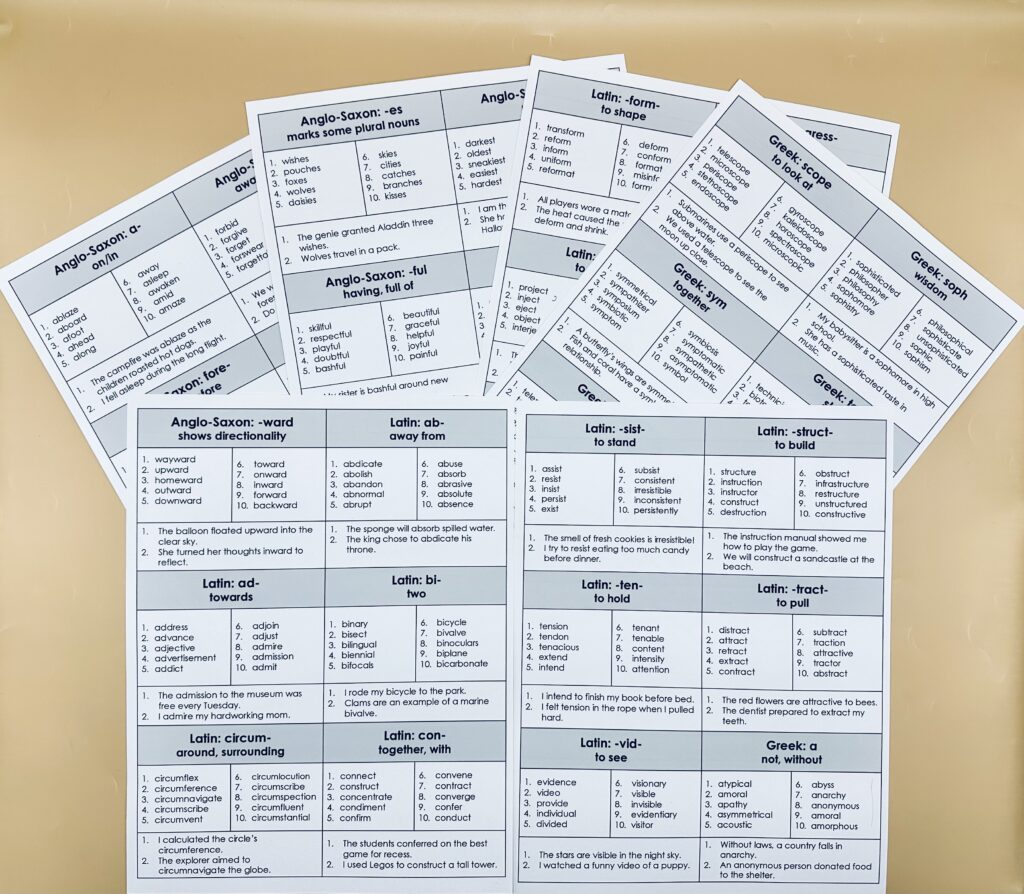
The key is that dictation should not focus only on the current skill. Instead, it should intentionally mix previously taught skills with new ones so students get the repeated practice they need to become proficient spellers. To support this, I created morphology and syllable type dictation lists. I recommend printing the lists and highlighting a skill each time it is taught. When it is time for dictation, you can quickly pull one or two words from the highlighted sections and have meaningful, stress-free practice ready to go.
Daily dictation with both old and new words is the kind of practice that moves skills from short-term memory into long-term memory and builds automaticity.
I had never heard of the Three Great Spelling Rules until a few years ago. Once I learned them, though, I no longer had to say things like, “I don’t know why we change the y to an i. We just do.” These rules actually explain when and why base or root words change when a suffix is added.
The Three Great Spelling Rules are starting to gain some traction in instructional spaces. But, like spelling instruction in general, they are often taught once and then students are expected to remember them forever. Without regular, intentional practice, that rarely happens. Most programs still have not found a meaningful way to embed these rules into ongoing instruction.
Let’s take a closer look at what the Three Great Spelling Rules are and how you can authentically incorporate them into your daily practice.
The CVC Doubling Rule states this: If a word ends in a consonant-vowel-consonant (CVC), you double the final consonant before adding a VOWEL suffix.
Let’s look at a few examples:
The silent e rule states this: If you are adding a VOWEL suffix to a magic e/silent e word, you drop the e and then add your suffix. If you are adding a CONSONANT suffix, you keep it.
Let’s look at a few examples:
These rules can even be difficult for adults. When no one ever teaches you when to change a base word, you’re left guessing. The 3 Great Spelling Rules takes students away from guessing and allows them to have a real strategy for spelling words multisyllabic words.
This is the hardest one. And just like the other two rules, your students will not get it the first time you practice it. Realistically, they will not get it the second or third time either. It takes extended practice to internalize these advanced spelling rules.
The Y Rule for Spelling states this: If you have a word that ends with a vowel + y, keep the y before adding a suffix. If you have a word that ends with a consonant + y, change the y to an i before adding a suffix. Exception: Do not change the y to an i when adding a suffix beginning with i.
Let’s look at a few examples:
This one strategy changed spelling for my students in intervention. The vowels are the trickiest component of spelling because there’s just such variability in the sounds, some sounds are lessened, and there’s even times where you can’t really hear a vowel sound (Looking at you, consonant + le syllable).
This strategy is a reliable way to improve spelling, almost immediately. It will not prevent all spelling mishaps, but it will provide improvement.
In English, vowels are the driving force of our syllables. I explain a syllable as “the opening and closing of your mouth around a vowel sound.” Each syllable must have at least one vowel, though they can have more. Teach your students that every syllable must have a written vowel.

Then, follow the procedure below students to spell tricky multisyllabic words. It is important to model this procedure several times before asking students to do it independently.
By giving them a strategy like this, we give students a self-checking mechanism for accuracy. And anytime we can help students gain independence in reading and spelling it’s a win.
When we step back and look at advanced spelling through the lens of providing practice and explicit encoding strategies, it becomes clear that strong spelling is not about talent. It is about instruction and practice. Students who struggle with multisyllabic spelling are not missing an ability. They are missing consistent opportunities to apply strategies that actually make English spelling predictable. Daily cumulative dictation, explicit spelling rules, and clear problem-solving strategies like ensuring every syllable has a written vowel give students a way to think through spelling instead of guessing. When we provide routines that build automaticity and strategies students can rely on, spelling becomes something students can improve at, not something they feel destined to be bad at.
Share This:

Savannah Campbell is a K-5 reading specialist. She has taught her entire 12-year teaching career at the school she went to as a child. She holds two master’s degrees in education from the College of William and Mary. Savannah is both Orton-Gillingham and LETRS trained. Her greatest hope in life is to allow all children to live the life they want by helping them to become literate individuals.
Savannah Campbell is a K-5 reading specialist. She has taught her entire 12-year teaching career at the school she went to as a child. She holds two master’s degrees in education from the College of William and Mary. Savannah is both Orton-Gillingham and LETRS trained. Her greatest hope in life is to allow all children to live the life they want by helping them to become literate individuals.
Feeling overwhelmed with all the terminology out there? Want to know the key terms all teachers need to teach phonics? In this FREE Rules of English cheat sheet, you get a 5 page pdf that takes you through the most important terms for understanding English—you’ll learn about digraphs, blends, syllable types, syllable divisions, and move. Grab today and take the stress out of your phonics prep!