
Share This:
Phonemic awareness is not the end goal of our reading classrooms. Neither is phonics knowledge or a certain number of correct words per minute. The ultimate goal of reading instruction is comprehension. Because it is so important, there has been a push towards ensuring that educators are using high-quality instructional materials. To that end, many states have enacted legislation requiring districts to choose a textbook from a chosen list.
The assumption is that the textbooks on the list are ones that will make the needle move for children. But here is a question that is rarely asked: Do we actually know what comprehension instruction looks like—both what is suggested from the textbook and then what is done inside real classrooms? For decades, researchers have been trying to answer that question by looking closely at what teachers do, what manuals ask them to do, and whether the two line up. The findings are both fascinating and incredibly relevant to our work today.
I’ve been working on a comprehension project for the past couple years with a few colleagues. It’s required me to read a lot of research about comprehension. And I always say that knowledge is power. So today, I simply want to share the knowledge I’ve learned about comprehension research with you.
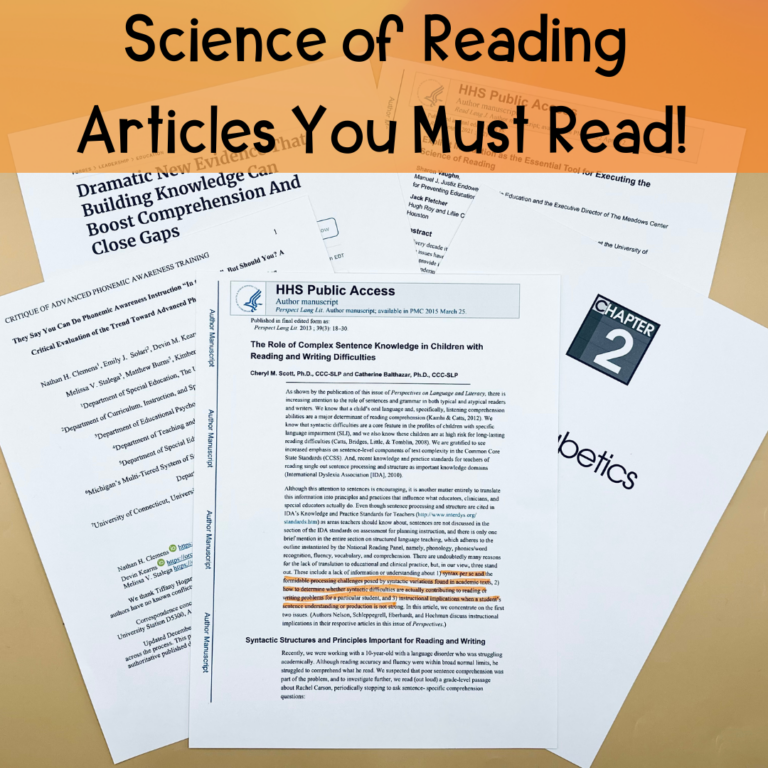
Please click on any image of the research article to be taken to a link to that article! If possible, I have found versions NOT behind a paywall.
In the late 1970s, researcher Dolores Durkin set out to observe how much time teachers truly spent teaching comprehension. She completed an observational study where she went inside classrooms to see what comprehension instruction occurred. Durkin defined comprehension instruction broadly as anything a teacher said or did “to help children understand or work out the meaning of more than a single, isolated word” (1979, p. 488).
Even with this wide definition, comprehension instruction was almost nonexistent. No, really.
In one fourth grade classroom, less than 1% of instructional time focused on comprehension. Nearly 18% of the time was spent on assessment, and about 40% of reading time involved completing assignments. When Durkin expanded her study to look at schools as a whole, the pattern stayed the same. In two schools she found no comprehension instruction whatsoever. In the third school she found only four minutes of it. Durkin concluded that “completing assignments and getting right answers seemed much more significant than concerns like ‘Do the children understand this?’ and ‘Will what I’m assigning contribute to reading ability?’” (p. 506).
Put simply, there wasn’t very much comprehension instruction happening in classrooms in the 1970s.

After witnessing how little comprehension instruction occurred, Durkin then examined the textbooks themselves. Were the manuals offering enough guidance for teachers to teach comprehension well?
She analyzed five major basal programs and counted every instance in which a manual suggested instruction, practice, assessment, application, preparation, or review. What she discovered mirrored her classroom observations. Instruction was always the smallest category. Practice and assessment appeared hundreds of times in each program, far outnumbering instances of actual teaching. One program had 128 suggestions for instruction but 693 for practice. Another had 60 suggestions for instruction but almost 500 for practice. While practice is extremely important, it should only be completed after solid instruction has been given.
Durkin concluded that the basal programs encouraged teachers to “teach by implication rather than by direct, explicit instruction” (p. 18). When students struggled, the manuals typically offered additional exercises rather than instructional support. In short, Durkin found that the textbooks provided very little guidance for comprehension instruction, but lots of worksheets for students to complete.

In 1983 Durkin conducted another study, this time observing how closely teachers followed the manuals they were given. Sixteen teachers were observed for nearly 2,000 minutes. Her goal was to see which parts of the manual teachers used faithfully, which sections they ignored, and whether patterns existed.
Durkin focused on several instructional categories: introducing new vocabulary in context, building background knowledge, asking pre-reading questions, silent reading, comprehension assessment questions, oral reading, instruction, practice assignments, and extra practice activities. Three teachers introduced vocabulary in context. None taught background knowledge. Only two teachers asked any pre reading questions. Oral reading appeared almost everywhere, and written practice assignments were used by every teacher. Originally, I was excited that there were so many written assignments-having students write about reading is excellent. Unfortunately, though, the written assignments just tended to be worksheets, NOT asking students to write about reading.
Durkin interviewed teachers to learn why they skipped so many instructional suggestions. The most common reasons were a lack of time and the belief that the suggested activities were not important. Many teachers described written assignments as useful because they kept students occupied.
Taken together, Durkin’s three studies revealed a consistent pattern. Comprehension instruction rarely occurred, manuals did not offer enough explicit guidance, and teachers did not follow the textbook as it was laid out. But, that was the 80s, and lots has changed since then, right?

Fast forward to 2008 when Dewitz, Jones, and Leahy examined five popular core reading programs to see whether comprehension instruction had changed. Their purpose was to identify which comprehension skills and strategies programs recommend, how these are intended to be taught, the nature of the instructional design, and whether the pacing matched the conditions under which strategies had been shown to be effective.
They found that “none of the programs cover comprehension skills and strategies with the intensity employed by the original researchers” (p. 120). Basically, there are a small set of reading strategies that DO have research to support their effectiveness. But none of these core reading programs taught those strategies to the same extent. For example, Taylor and Beach (1984) taught summarizing for 1 hour a week for 7 weeks. In the core reading programs examined, summarizing only had between 2 and 6 instructional occurrences.
They found that questioning still dominated comprehension instruction. In some programs questioning took up more than half of the entire instructional block. Although there were more references to comprehension instruction than in Durkin’s time, the instruction frequently lacked explicit explanation. Many programs offered insufficient instructional time, and all lacked the massed practice needed when skills were first introduced; in several cases, programs did not return to the strategy for weeks.
Another concern was the sheer number of strategies covered. Programs often expected teachers to address 18 to 29 strategies per year, far more than the small set of high impact strategies recommended by major research groups such as the National Reading Panel (2000) and the RAND Reading Study Group (2002).
Their conclusion was that while programs had changed, the changes did not fully reflect the kind of explicit, intensive instruction that research supports.

A recent study by Capin and colleagues (2025) offers a new look at comprehension instruction by examining 62 observational studies conducted between 1980 and 2023. These studies represented 1,784 teachers across kindergarten through twelfth grade.
Since Durkin’s seminal studies, has anything changed concerning comprehension instruction? Well, there is good news. Instructional time devoted to comprehension has increased significantly. While Durkin reported less than 1% of time spent on comprehension instruction, Capin and colleagues found an average of 23%. This is a major shift, although the range across studies varied widely from as little as 3% to as much as 44%, with eight studies reporting less than 20% of instructional time devoted to reading.
The researchers also examined which research-based practices appeared in classrooms. Developing background knowledge and strategy instruction were among the most commonly observed practices, followed by vocabulary and extended discussion. Less common were purposeful text selection and instruction designed to build student motivation and engagement. The authors found a statistically significant difference between the presence of research-based practices and the year of publication. On average, studies that were published after 2000 witnessed more evidence-based practices. This provides so much hope for the direction of core reading programs.

A study by Reutzel, Child, Jones, and Clark in 2014 focused on the amount and quality of explicit instruction inside five core reading programs. They wanted to determine how much of and what kind of explicit instructional moves were recommended. They examined lessons from first, third, and fifth grade and coded seven components of explicit teaching.
Out of 1,574 coded instructional moves, direct explanation accounted for 22%, discussion for 20%, and modeling for 19%. Independent practice, monitoring, and feedback were far less common. Feedback appeared only 1% of the time.
More than half of these instructional moves targeted comprehension, which might seem encouraging, but the limited presence of guided practice, monitoring, and feedback pointed to important gaps in the instructional design.

Across decades and across instructional programs, the story is remarkably consistent. Comprehension instruction has often taken a back seat to assessment, practice, and busywork. Teacher manuals have not always provided the explicit instructional guidance teachers need. Even when programs do include strategy instruction, they sometimes lack the modeling, guided practice, and intensity that research shows are necessary.
The encouraging part is that we are making progress. There is more comprehension instruction occurring now than in Durkin’s time, and textbooks published after 2000 show a stronger focus on research-aligned practices. Teachers want to teach comprehension well. They simply need materials and training that match that desire.
This post is not meant to villainize core reading programs or dismiss the hard work teachers are doing every day. Instead, it is meant to equip you with knowledge. When we understand what decades of research actually say about comprehension instruction, we are no longer relying on assumptions, marketing language, or pacing guides to make instructional decisions. We are relying on evidence. And that matters, especially in an era when fidelity to a program is often emphasized without equal attention to whether that program truly aligns with how children learn to comprehend text.
Knowing this research gives teachers professional power. If you are expected to teach from a core program that emphasizes practice over instruction, assessment over modeling, or coverage over depth, you are not being “defiant” by questioning it. You are being informed. The studies cited here show that many programs, even well regarded ones, have historically underdelivered on explicit, intensive comprehension instruction. That does not mean you abandon your materials. It means you read them critically, supplement them intentionally, and advocate for the instruction your students actually need.
When teachers understand the research, they are better positioned to make thoughtful instructional moves, to push back when necessary, and to have meaningful conversations with coaches, administrators, and districts. Research does not take power away from teachers. It gives it back.
Receipts below, aka citations for the research studies.
Capin, P., Dahl-Leonard, K., Hall, C., Yoon, N. Y., Cho, E., Chatzoglou, E., Reiley, S., Walker, M., Shanahan, E., Andress, T., & Vaughn, S. (2025). Reading comprehension instruction: Evaluating our progress since Durkin’s seminal study. Scientific Studies of Reading, 29(1), 85–114. https://doi.org/10.1080/10888438.2024.2418582
Durkin, Dolores (1979). “What classroom observations reveal about reading comprehension instruction.” Reading Research Quarterly: 481-533.
Dewitz, P., Jones, J., & Leahy, S. (2009). Comprehension strategy instruction in core reading programs. Reading Research Quarterly, 44(2), 102–126. https://doi.org/10.1598/RRQ.44.2.1
Durkin, D. (1981). Reading comprehension instruction in five basal reader series. Reading Research Quarterly, 515-544.
Durkin, D. (1984). Is there a match between what elementary teachers do and what basal reader manuals recommend?. The Reading Teacher, 37(8), 734-744.
Reutzel, D. R., Child, A., Jones, C. D., & Clark, S. K. (2014). Explicit instruction in core reading programs. The Elementary School Journal, 114(3), 406-430.
Share This:

Savannah Campbell is a K-5 reading specialist. She has taught her entire 12-year teaching career at the school she went to as a child. She holds two master’s degrees in education from the College of William and Mary. Savannah is both Orton-Gillingham and LETRS trained. Her greatest hope in life is to allow all children to live the life they want by helping them to become literate individuals.
Savannah Campbell is a K-5 reading specialist. She has taught her entire 12-year teaching career at the school she went to as a child. She holds two master’s degrees in education from the College of William and Mary. Savannah is both Orton-Gillingham and LETRS trained. Her greatest hope in life is to allow all children to live the life they want by helping them to become literate individuals.
Feeling overwhelmed with all the terminology out there? Want to know the key terms all teachers need to teach phonics? In this FREE Rules of English cheat sheet, you get a 5 page pdf that takes you through the most important terms for understanding English—you’ll learn about digraphs, blends, syllable types, syllable divisions, and move. Grab today and take the stress out of your phonics prep!