
Share This:
Did you know that by the time children exit high school, they have a reading vocabulary of around 50,000 words? (Graves, 2006, p.4). We only use a few thousand words in our oral language, so where do our students learn the remainder of the vocabulary words? Direct instruction can only teach but so many words. The truth is that over time, the largest contribution to a child’s vocabulary development is wide reading (Graves, 2006).
So does that mean? Do we just make sure all students are reading for 20 minutes at home each night and receiving independent reading time in class? Access to reading time is a start, but it doesn’t guarantee vocabulary acquisition. Instead, we need to teach our students word-learning strategies: that is, strategies to help them acquire new vocabulary words. (Also, this is me not being able to be chill or humble because it’s the coolest thing that has happened to me, but we talk about this in our new book* coming out through Scholastic next year!)
The three word-learning strategies that students need to learn are morphology, context clues, and reference sources. Vocabulary learning CAN happen independently, but we must teach our students HOW. Word learning strategies are the answer.
I used to think about morphology as a continuation of phonics instruction. Where in the primary grades we teach students to read and spell basic phonics patterns, I thought it was as simple as taking the time in the upper elementary grades to teach morphology to assist students with learning to read and spell multisyllabic words.
And that is a part of it. Explicitly teaching students how to look for morphemes they know while reading and spelling is a huge component of morphology. But it goes a little bit deeper than that because morphology isn’t just about decoding and encoding, it’s about understanding individual word parts.
A morpheme is the smallest unit in a word that carries meaning. It can be a single letter, like adding -s to the end of a noun to make it plural. It might be a syllable or two, such as the three morphemes in un-think-able. A morpheme can even be an entire word, like the word Virginia. The power in morphemes lies in that provide clues to a word’s meaning.

When we explicitly teach prefixes, suffixes, and roots, we help our students to look for meaningful word parts while reading. If a student were to come across the word malfeasance in a sentence, they might not understand the full meaning, but a knowledge of the morpheme “mal” would let them know that there is a negative connotation to this word.
Morphology matters because it is the tool that can help students uncover the meaning of large numbers of words by simply learning high-utility prefixes, suffixes, and roots. If you’re looking for more information about explicitly teaching morphology, you can learn more here.
As proficient readers, we don’t often have to use morphology or context clues. Because reading seems to flow so effortlessly for many of us as adults, knowing how these word learning strategies can be helpful is often an abstract idea. We don’t typically do it, so we don’t always see the immense value in teaching it to our students.
But look at these lines from Dragonfly in Amber, the second novel in the Outlander series: He giggled in that high-pitched way again, and made his way to the sideboard, remarking over his shoulder, “Captain Randall said you were a most diverting woman. Quite an encomium from the Captain, you know. He hasn’t much use for women ordinarily, though they swarm over him”(p.649).
Chances are, you don’t have a deep understanding of the word encomium (look, I don’t even have a deep understanding of it and I’ve been using this example since I read it in Outlander). BUT, are you able to get a basic understanding of what the word means? By reading it, I know that it is a positive term, and it seems like it is a compliment. I may not know the exact definition of the word, but I am able to know enough to continue reading without comprehension breaking down.
That is the power of context clues. When we teach students to search for clues in a sentence while they are reading, we are helping them to develop a word-learning strategy that they can utilize when they aren’t with us.
Teaching context clues is not about handing students a list of signal words. It is about helping them become detectives of meaning. Begin by modeling your thinking aloud as you read. Show students exactly what you notice, what you predict, and how the surrounding information helps you rule things in or out. Then move into guided practice with short, high-interest sentences where only one clue type is present at a time, such as definition, synonym, contrast, or example.

As students gain confidence, increase the complexity by giving them sentences with implied clues rather than explicit ones. Most importantly, anchor this work in real reading. When students encounter an unfamiliar word during shared reading, pause and ask, “What can we figure out from here?” This consistent and embedded practice helps them internalize the habit of turning to the text before turning to the teacher, which is a skill strong readers use every single day.
I’ve avoided talking about reference materials for most of my professional career. Why? Because they simply haven’t been useful for the students I work with. As a reading interventionist, I know that most of the words in a dictionary or thesaurus are unfamiliar to my students. If a child is already struggling to read a word, asking them to look up a dictionary definition only adds more unknown words to the mix. And asking a student who cannot spell a word to find it alphabetically is almost guaranteed to end in frustration. When the task is harder than the reading problem itself, the “tool” just becomes another demand for a student’s already-taxed cognitive load.
But as a proficient reader, I do use a dictionary. I don’t use it often, and I only turn to it when the other two word-learning strategies can’t help. If morphology and context clues do not give me enough information to understand a word, a dictionary can be incredibly helpful. Still, this is an advanced skill, and it does not come naturally to students. A single “dictionary skills” week will not make learners see a dictionary as a meaningful tool. They need repeated, purposeful opportunities to use reference materials in ways that support rather than overwhelm them.
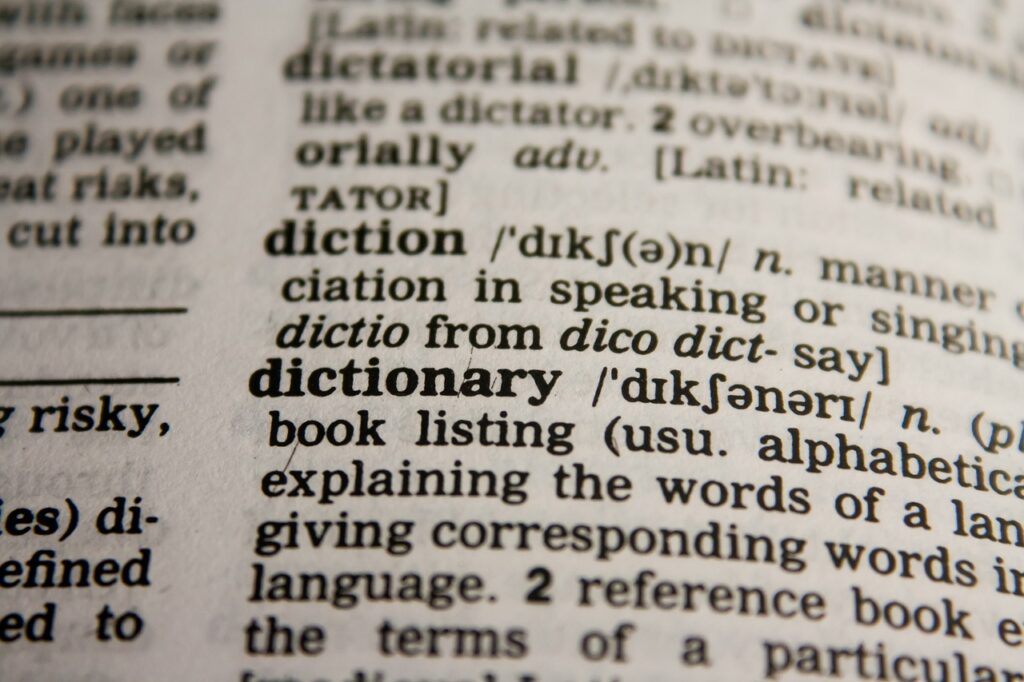
Teaching students to use reference materials effectively starts with intentional modeling. Begin by showing students the exact moments when you would choose to consult a dictionary or thesaurus. Explain why the other strategies did not work and how a reference source can fill in the gaps. Next, practice together with carefully selected words that students are likely to recognize or at least partially decode. This helps reduce cognitive load and allows them to focus on the process rather than the difficulty of the vocabulary. Over time, introduce short, structured tasks where students learn to navigate guide words, choose the correct definition for the context, or compare shades of meaning between synonyms. The key is frequency and authenticity. When students see dictionaries and digital reference tools used in real reading, not just in isolated lessons, they begin to understand how these resources can support their comprehension instead of complicating it.
As teachers, we know we cannot directly teach students every word they encounter, but we can give them the tools that make independent word learning possible. When students understand how to use morphology, context clues, and reference materials, they begin to approach unfamiliar words with confidence rather than hesitation. Wide reading will always play the biggest role in vocabulary growth and word-learning strategies ensure that students can actually make sense of the new words they meet along the way. If we want our readers to thrive long after they leave our classrooms, teaching them how to learn words on their own is one of the most powerful gifts we can give.
Resources Mentioned:
The Vocabulary Book by Michael Graves
*As an Amazon affiliate, I may make a small commission from products purchased through my affiliate links, at no additional charge to you.
Share This:

Savannah Campbell is a K-5 reading specialist. She has taught her entire 12-year teaching career at the school she went to as a child. She holds two master’s degrees in education from the College of William and Mary. Savannah is both Orton-Gillingham and LETRS trained. Her greatest hope in life is to allow all children to live the life they want by helping them to become literate individuals.
Savannah Campbell is a K-5 reading specialist. She has taught her entire 12-year teaching career at the school she went to as a child. She holds two master’s degrees in education from the College of William and Mary. Savannah is both Orton-Gillingham and LETRS trained. Her greatest hope in life is to allow all children to live the life they want by helping them to become literate individuals.
Feeling overwhelmed with all the terminology out there? Want to know the key terms all teachers need to teach phonics? In this FREE Rules of English cheat sheet, you get a 5 page pdf that takes you through the most important terms for understanding English—you’ll learn about digraphs, blends, syllable types, syllable divisions, and move. Grab today and take the stress out of your phonics prep!


