Share This:
One of my strongest memories from 5th grade is going to the Scholastic Book Fair with my mom and picking out a Dear America book. It’s been almost 30 years since that day, and I still have that book.
Lately, I’ve been thinking about that little 5th grade girl and how excited she would be to see her name in a book published by Scholastic. As exciting as that is for me, and as much as this truly is a dream come true, this really is not about me.
It has to be about the kids. It has to be about doing everything I can to help them become more proficient readers and helping their teachers feel more confident in their instruction.
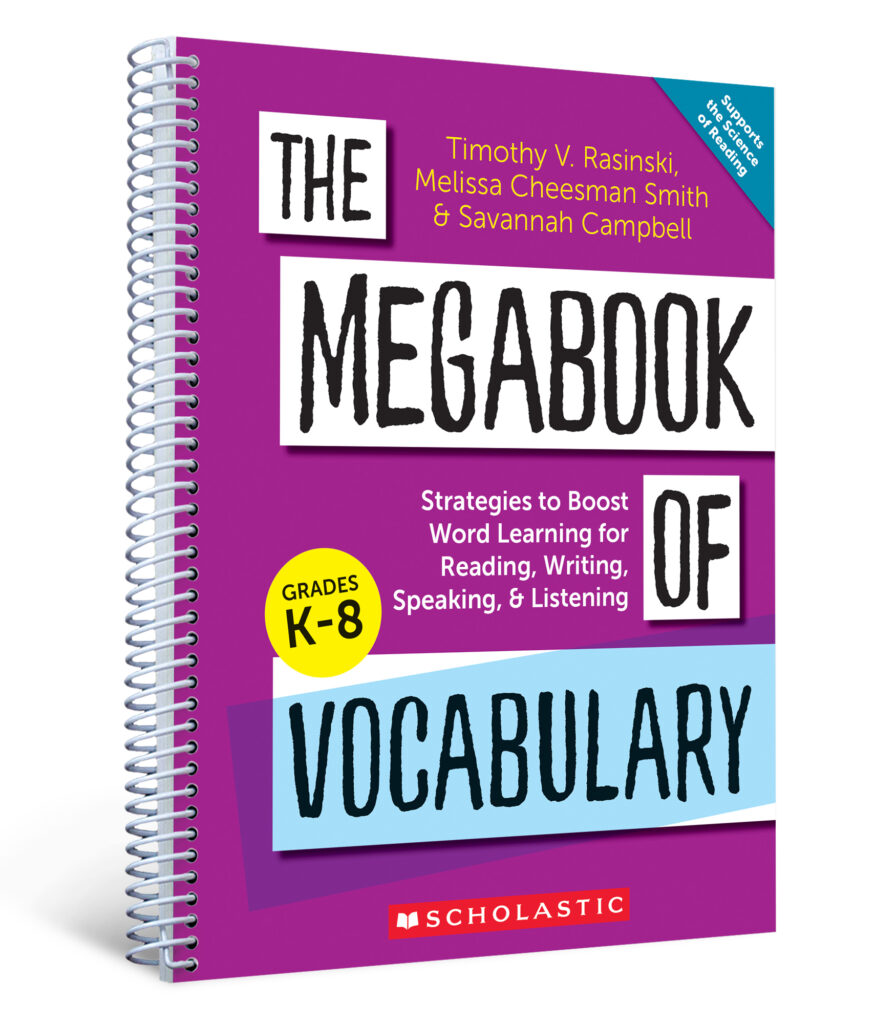
That’s what The Megabook of Vocabulary is about. I had the honor of co-writing this book with Tim Rasinski and Melissa Cheesman Smith, and it is finally out in the world. Over the past few years, I have made it my goal to learn everything I could about vocabulary. We know vocabulary is directly tied to reading comprehension, and reading comprehension is the end goal of everything we do.
But vocabulary instruction is so much more than just “teaching words of the week.”
To truly grow and sustain an expansive vocabulary, we can’t just explicitly teach words. We need to be much wiser than that (pun must definitely intended), so let’s get into it. The W.I.S.E framework is what my co-authors and I coined to illustrate the 4 core elements of vocabulary instruction. For real, meaningful, and deep vocabulary acquisition to occur, all four need to be in place for our students.
The “W” in W.I.S.E. stands for word consciousness. Word consciousness is the most difficult of the elements to “teach” because it is not something you can simply assign. Word-conscious students are curious about the words they encounter and precise about the words they choose. It shows up when a student is speaking and lands on exactly the right word, or when they are writing and intentionally select the best fit for their sentence.
I’m going to be a proud mama for a moment and brag on my daughter to help illustrate this.
Last night, I told Ember we were having tacos for dinner. She is like most 6-year-olds in that, despite my best efforts, chicken nuggets are very much considered a food group.
She said, “Mama, I only want cheese on my taco.”
I responded, “Girl, you’ve got to have a little bit of meat on that.”
And she came right back with, “I only want one speck of meat on my taco!”
Not a scoop. Not a spoonful. Not even a tiny bit. That girl wanted a speck, and she knew it.
That is word consciousness. It is that awareness and curiosity about words that help students grow their vocabulary so they can choose exactly the right word when it matters.
Imagine a school-wide parade, but instead of celebrating the New Year, graduation, or cheering on 3rd–5th graders before testing, we’re celebrating words. Each child in the parade is assigned a vocabulary word and creates props, signs, or costumes to help bring that word to life. The preparation can happen at school or at home, with the final parade taking place during the school day.
Typically, one grade level participates in the parade itself while the rest of the school becomes the audience lining the halls and cheering them on. If you want to create a school culture where students are thinking about, talking about, and excited about words, it’s hard to imagine a better way to do it. (I mean, unless you have the book, then I have a feeling you could find a few more ways. 😉)

For most of my teaching career, I really thought vocabulary instruction was just about individual word learning. This is the element that is most immediately recognizable to many teachers because it involves the direct teaching of specific words.
There are three keys to teaching individual words if we want them to stick.
First, we must provide kid-friendly definitions. Asking a child to look up a word in the dictionary often leads to more confusion than clarity because dictionary definitions are notoriously difficult for students to understand.
AI can be a great tool for generating kid-friendly definitions. Try a simple prompt like this: Please create a kid-friendly definition for the word ______ written at a ______ grade level.
Second, students need to see words used in context. Vocabulary instruction cannot rely on rote memorization alone because it simply does not work. And rote memorization includes things like matching words to definitions or writing vocabulary words three times each. Students need opportunities to see and hear words used naturally in meaningful sentences and situations, and they need far more than a single exposure.
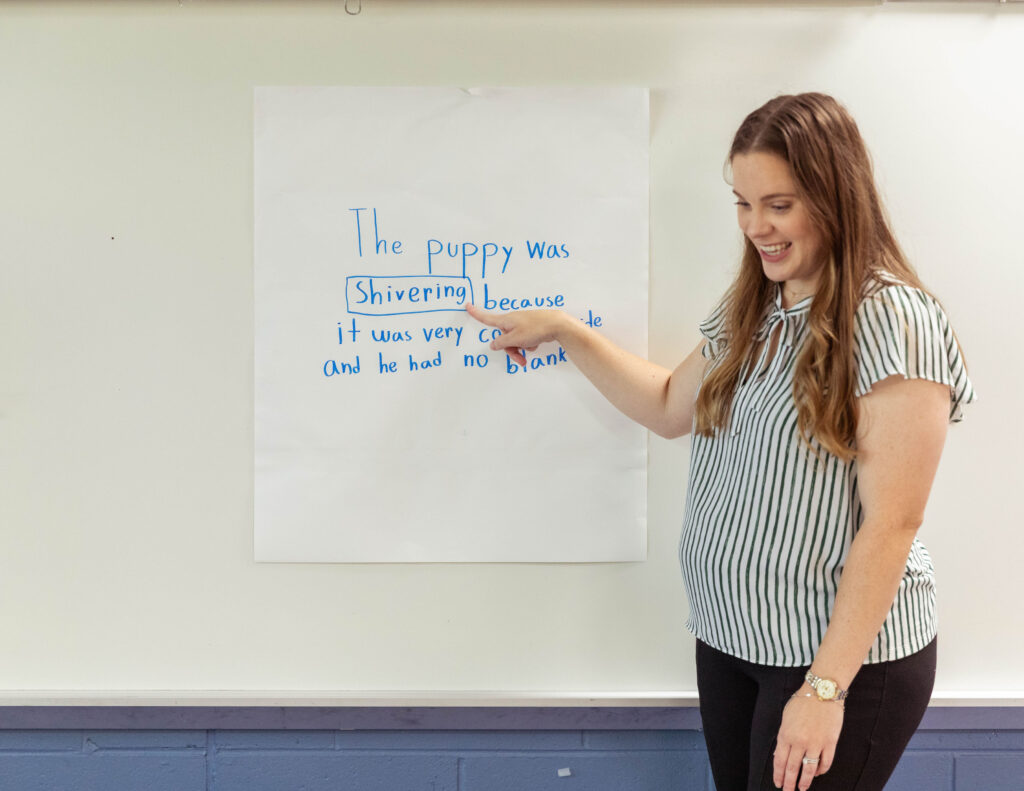
Which leads to the final key for teaching individual words: multiple exposures. Many core reading programs tend to follow the same cycle. Introduce the vocabulary words on Monday, read the story where the words appear, complete a few practice activities throughout the week, and then give a quiz on Friday. Rinse and repeat all year long.
But how often do those programs revisit those words later? How often do they intentionally remind students of them or point them out again in new contexts? I love that the strategies in our book can help you to take vocabulary from “something the textbook is making me do” to something you’re excited about tackling with your students.
We split our word learning strategies into two different categories: strategies using your own words, and strategies using words we provide. That way, whether you’re creating from scratch or using a core reading program, you’ll have a plethora of strategies to choose from.
You know those last five minutes of class when you’ve finished everything you needed to teach, but you also do not want your classroom to descend into complete chaos? These Choose Your Own Adventure stories are the perfect solution.
Each story includes stopping points where students must choose the correct vocabulary word before moving on. Depending on the word they choose, they either continue the adventure… or it’s game over. For example, when you arrive at some strange inscriptions on the wall, will you scrutinize, deface, or disregard the inscriptions?
They are exactly like the Choose Your Own Adventure stories from our childhood, but with a vocabulary twist that keeps students engaged and learning until the bell rings.
Teaching a few “words of the week” will never be enough to grow vocabulary to the extent students need. Once children begin school, they learn approximately 3,000 new words each year (Graves, 2016). We could never directly teach that many words one by one. When it comes to long-term vocabulary development, nothing plays a bigger role than wide reading. The more children read, the more opportunities they have to encounter new words and grow their vocabularies.
But vocabulary growth is not just about putting books in front of students. We also have to give them tools for figuring out unfamiliar words independently. That is where context clues, morphology, and reference materials come into play. We call these Student Tools for Determining Meaning because they help students build a toolbox they can rely on while reading. When students encounter an unknown word, these tools help them determine enough meaning to keep comprehension moving forward.
With context clues, we teach students to look around in the sentence for hints about a word’s meaning. This is not the same as the three-cueing system, which asks students to use surrounding text to figure out how to read a word. Context clues are directly tied to meaning.
For example, imagine a student reads the sentence: After running the marathon, Marcus was completely famished and ate three slices of pizza in minutes.
Even if the student has never seen the word famished before, the surrounding clues help reveal the meaning. Marcus ran a marathon. He ate three slices of pizza quickly. The student can infer that famished probably means extremely hungry. They may not arrive at a perfect dictionary definition, but they can understand the sentence well enough for comprehension to continue.
Then, the next time your student sees the word famished, they will already have at least a general connotation of that word. As the word is seen and utilized in different scenarios, word learning happens IF we can teach students to extract meaning from the surrounding sentence.
Morphology is another powerful student tool, and if you have followed me for any length of time, you already know it is my absolute favorite. While context clues are a great strategy for uncovering meaning, there aren’t always enough clues in a sentence to help. Morphology is another strategy for determining meaning because when students recognize meaningful word parts, they can begin figuring out unfamiliar words the same way they once decoded words in early reading. They take the word apart, examine the pieces, and put it back together to make meaning.
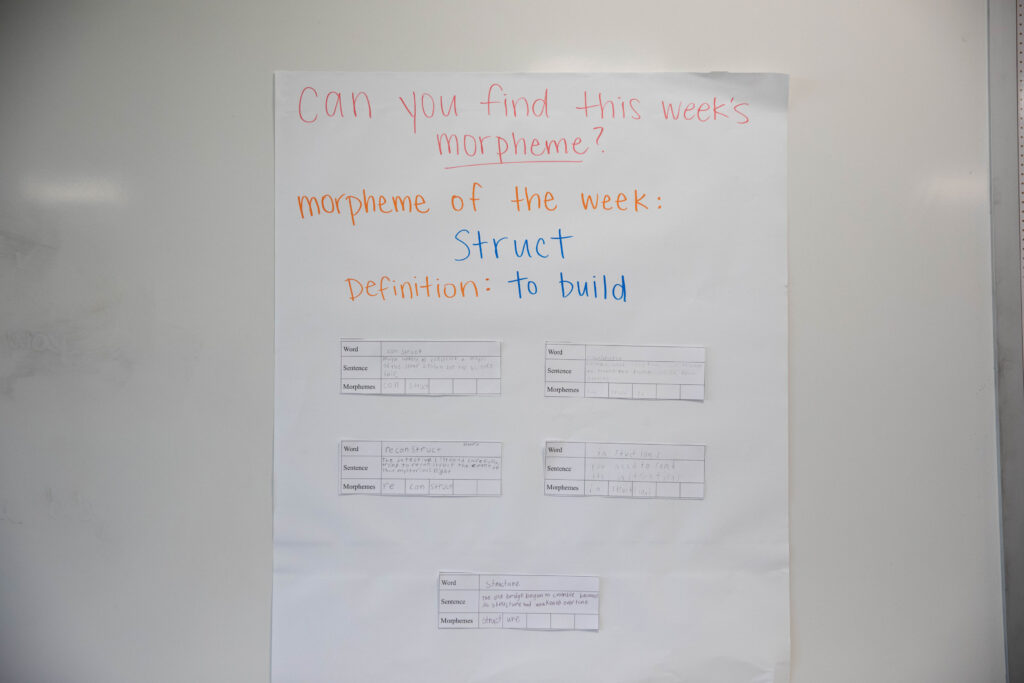
For example, if a student knows the morpheme -tract- means “to pull,” they begin to notice that root showing up again and again in different words: distract, distraction, retract, subtract, attractive, unattractive, and detract.
Suddenly, those words are no longer random collections of letters. They are connected through meaning.
Imagine a student comes across the sentence: The loud noise distracted Maya during her test.
Even if the student has never seen the word distracted before, knowledge of morphology can help. The prefix dis- often means apart or away, and -tract- means pull. The student can begin to infer that distracted means something “pulled her away” from her focus. Once again, they may not arrive at a perfect dictionary definition, but they can understand the sentence well enough for reading to continue without comprehension failing.
The final Student Tool for Determining Meaning is the one that should be used as a last resort—the dictionary. Tell me the last time you pulled out your physical dictionary and used guide words to find the meaning of a word. It’s become almost obsolete, and I’m not interested in spending a lot of time teaching things that won’t be highly beneficial for my students.
I absolutely love Morphology Chains. When I first started my science of reading journey, my entry point was explicit phonics instruction. It was not until much later that I began learning about morphemes and multisyllabic word instruction. And once I did, I could not stop wondering why we did not have more explicit instructional resources for morphology the way we do for basic phonics skills.
So I started creating morphology activities modeled after the kinds of resources I already loved using with younger students, things like visual drills, dictation, and word mapping. My favorite of all of them became Morphology Chains.
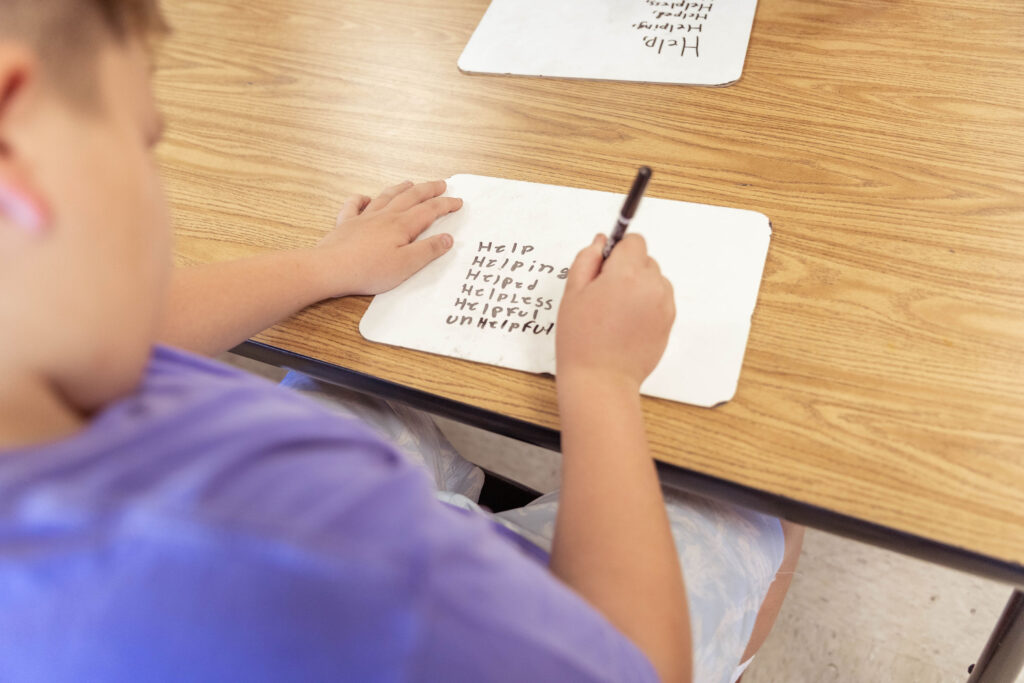
Instead of changing one sound in a word, students change one morpheme at a time. For example, mistake might become mistaken, which then becomes mistakenly. Students can visually see how adding or changing morphemes impacts both meaning and function within the sentence.
It is such a fun and engaging way to draw students’ attention to meaningful word parts while simultaneously strengthening vocabulary, spelling, and comprehension.
The most effective teaching connects what students already know to new learning, and nowhere is that more evident than in word relationships. Word relationships include concepts such as “multiple meanings, word categories, figurative language, nuances, analogies, and connotations” (Rasinski et al., 2026, p. 226). When we teach word relationships, we are teaching far more than isolated vocabulary words. We are helping students understand how words connect, interact, and change meaning depending on context.
Take nuances in word meaning, for example. Words like happy, cheerful, delighted, and ecstatic all relate to the same general idea, but they are not interchangeable. A student who understands nuances realizes that someone who is ecstatic is experiencing a much stronger emotion than someone who is simply cheerful. That deeper understanding allows students to be more precise in both their reading and writing.
Instead of just learning a definition, students begin to think critically about why an author chose one word over another. They start noticing that words carry shades of meaning, emotion, and tone. That kind of understanding is what helps students move from basic comprehension to truly sophisticated language use.
I really love activities that challenge students to think about language and writing in new or interesting ways. As someone who grew up teaching in a Writing Workshop world, I rarely asked my students to complete highly specific writing tasks. At the time, I worried that doing so might take away their voice or their joy as writers.
Looking back, I know my heart was in the right place, but I also realize something important. If we never explicitly teach students how to make intentional moves as writers, how can we expect them to do it independently? While some students may naturally develop stronger writing skills earlier than others, I refuse to believe that some children are simply destined to be poor writers.
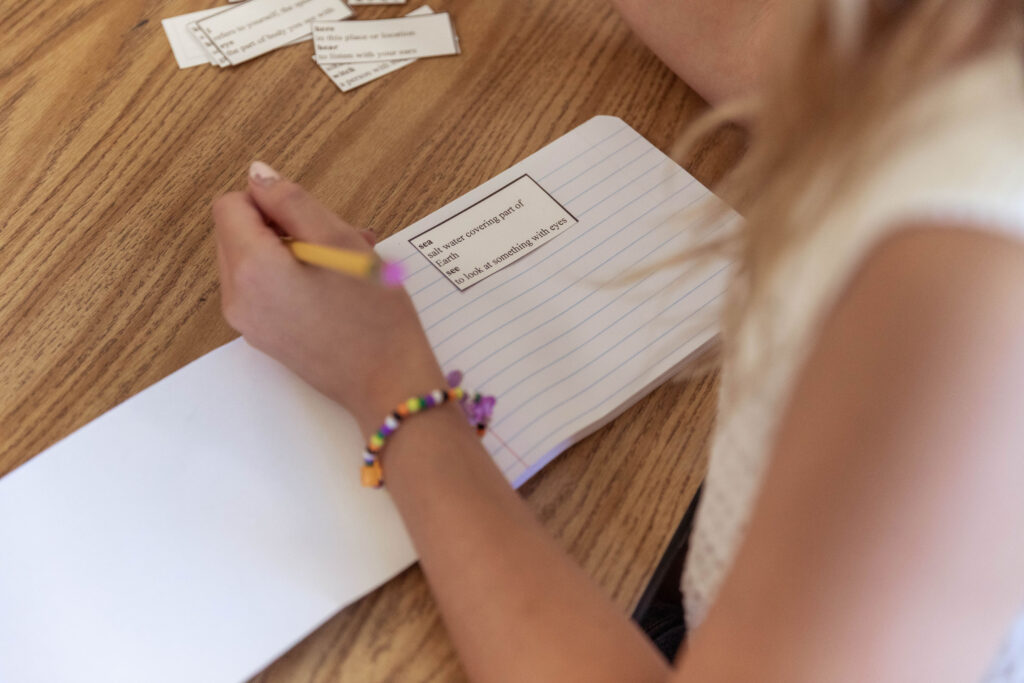
That is one of the reasons I love the activity Two Words, One Sentence.
In this activity, students are challenged to use a pair of homophones correctly within a single sentence. We included more than 60 different homophone pairs in the book for students to work with. Students choose a card and then create a sentence using both words correctly in context.
For example, with the pair weak and week, a student might write: When I was sick for a week, my body felt very weak.
Activities like this push students to think deeply about meaning, spelling, and usage all at the same time, while still feeling engaging and playful.
At the end of the day, vocabulary instruction is not about memorizing a list of words on Monday and hoping students remember them by Friday (before promptly forgetting and never revisiting again). It is about building curious, thoughtful readers and writers who notice words, think deeply about meaning, and have the tools they need to grow their vocabularies independently over time. That is exactly why we wrote The Megabook of Vocabulary. We wanted to create a resource that moved beyond “words of the week” and gave teachers practical, engaging, research-based strategies they could immediately use in their classrooms.
Whether you are looking for ways to build word consciousness, strengthen morphology instruction, increase meaningful word exposures, or help students explore word relationships, this book is packed with ideas to help make vocabulary instruction something your students actually look forward to.
References
Graves, M.F. (2016). The vocabulary book: Learning and instruction (2nd ed). Teacher’s College Press
Rasinski, T., Cheesman Smith, M., & Campbell, S. (2026). The Megabook of Vocabulary. Scholastic
*As an Amazon affiliate, if you make a purchase using my affiliate link, I may earn a small commission, at no additional cost to you.
Share This:

Savannah Campbell is a K-5 reading specialist. She has taught her entire 12-year teaching career at the school she went to as a child. She holds two master’s degrees in education from the College of William and Mary. Savannah is both Orton-Gillingham and LETRS trained. Her greatest hope in life is to allow all children to live the life they want by helping them to become literate individuals.
Savannah Campbell is a K-5 reading specialist. She has taught her entire 12-year teaching career at the school she went to as a child. She holds two master’s degrees in education from the College of William and Mary. Savannah is both Orton-Gillingham and LETRS trained. Her greatest hope in life is to allow all children to live the life they want by helping them to become literate individuals.
Feeling overwhelmed with all the terminology out there? Want to know the key terms all teachers need to teach phonics? In this FREE Rules of English cheat sheet, you get a 5 page pdf that takes you through the most important terms for understanding English—you’ll learn about digraphs, blends, syllable types, syllable divisions, and move. Grab today and take the stress out of your phonics prep!