
Share This:
When I taught first grade, I invited all my parents and administrators to our “Writer’s Celebration.” My firsties and I had been working on personal narratives for weeks. We planned. We revised. We edited. And finally, we were ready to celebrate.
The day arrived, and my classroom was full. Twenty-ish first graders, grown adults hilariously squeezed into tiny chairs, administrators lining the walls, snacks everywhere, and our beloved Author’s Chair front and center.
One by one, students sat in front of the room and read their pieces. I remember feeling so proud, because this was their work. Not what I wanted from them. Not something polished by me. They chose the topic. They crafted their message. They made the edits. I wanted everyone to see what they could do, not me.
At the time, I held students accountable only for spelling patterns I had explicitly taught. Beyond that, I encouraged invented spelling almost exclusively. I truly believed that correcting spelling would ruin their relationship with writing. I didn’t want writing to become red pen marks and the internal message of “I can’t do this.”
And their writing reflected that. I even remember one administrator saying, “Wow, I can’t wait to see how much they’ll grow by the end of the year” with widened eyes as she examined a first grader’s paper.
Looking back, my heart was absolutely in the right place.
I know something I didn’t know back then: providing feedback and correction in writing, especially when it comes to spelling, is not cruel. When we help students become competent spellers, we are not taking anything away from them. Instead, we are giving them something—the ability to communicate clearly and efficiently in writing.
Like I always say, knowledge is power. And when it comes to spelling, knowledge of phoneme-grapheme correspondences, spelling patterns, and multisyllabic words matters. A lot. The goal isn’t perfection. It’s independence, and knowing how to move forward when a word doesn’t come easily. Today, I want to talk about some strategies that we can use for improving spelling, from basic single-syllable words through multisyllabic words.
When students are spelling independently, they need strategies they can actually use in the moment. Not reminders to “try their best,” but concrete, repeatable actions that help them problem-solve through a word.
Let’s look at a simple strategy for both single-syllable words and multisyllabic words.
The most powerful routine we can teach students when they are first learning to spell is this: Say the word. Tap the sounds. Say the sounds as you spell them.
It sounds simple, but it is incredibly effective.
When students tap out each phoneme and then say each sound as they write the corresponding grapheme, they are strengthening the connection between speech and print. They are no longer guessing based on how a word looks. They are building it sound by sound.
This is the foundation of spelling. THIS is how we help to facilitate orthographic mapping.

We cannot overestimate the importance of that verbal link. When students say the sounds as they write them, they are reinforcing phoneme-grapheme correspondences in real time. That is what leads to orthographic mapping and long-term word storage.
If students can internalize this process (say the word, tap the sounds, say the sounds as you spell) they have a tool they can use on almost any unfamiliar word. Will it always yield perfect spelling? Absolutely not, but it is a routine that they can fall back on directly rooted in how orthographic knowledge is acquired.
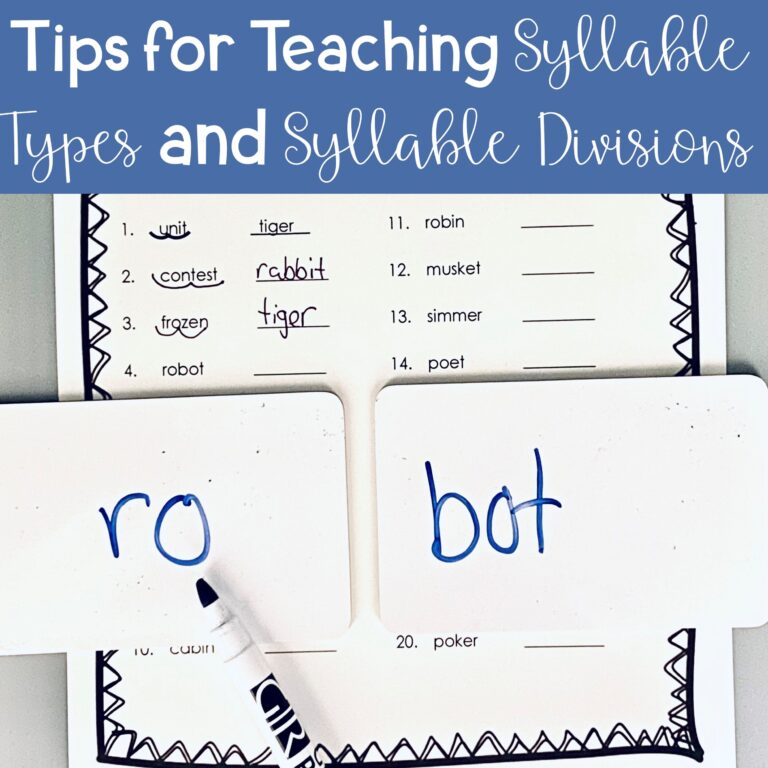
Once words become longer, students need a different kind of scaffold to help them stay organized. One of the most helpful strategies you can teach is this: Every syllable must have a written vowel.
This gives students a concrete way to check their work and make sense of longer words. We know that vowels are often the trickiest part of spelling. They can be reduced, part of vowel teams, or influenced by r-controlled patterns. Because of this, students often omit them or use them incorrectly.
This strategy gives them an anchor.
If a student hears five syllables, there must be at least five written vowels. That simple idea helps them slow down and attend to each syllable, rather than rushing through the word.

It also reinforces an important concept: Syllables are organized around vowel sounds. Our mouths open and close for the vowel, creating the syllable.
Here is a simple routine you can teach:
This doesn’t guarantee perfect spelling, but it gives students a structure. And that structure helps them approximate more accurately, notice when something is missing, and revise with intention.
Have you heard of the 3 Great Spelling Rules? Picture this: a student writes, “I tryed to stay up late but I fell asleep.”
What do you say? Do you just tell them, “That’s wrong, it’s tried”? Or are you able to explain why that change happens?
For a long time, I couldn’t. I would correct it, students would fix it, and we would all move on with our lives. But their spelling didn’t actually improve. Conditional knowledge is a huge missing link in a lot of education today. Meaning, we often teach students patterns and strategies, but we don’t always teach them when to use those strategies.
That changed when I started explicitly teaching the 3 Great Spelling Rules—the patterns that explain how base/root words change spelling when we add suffixes:
These rules give students a why. Instead of memorizing individual words, they begin to understand patterns they can apply across hundreds of words. But just like anything else, students don’t learn this from a one-time lesson. They learn it through consistent, daily practice.
One of the simplest and most effective routines is to have students manipulate a base word in real time. For example:
In a minute or so, students are applying the same rule multiple times. They see how the word changes, they hear it, and they write it. This kind of practice builds flexibility and pattern recognition. Students stop guessing and start thinking.
And that’s the goal. Not memorizing words one at a time, but giving students the tools to approach new words with confidence and a plan.
Teaching morphology is a critical strategy for word learning. But when we teach morphology, we are also directly supporting spelling.
English is a morphophonemic language. This means our spelling system represents both sound (phonemes) and meaning (morphemes). In other words, we don’t spell based on sound alone. We also spell to preserve meaning.
This is easy to see in simple words. Take the word cat. Each sound maps cleanly to a letter: /c/ → c, /a/ → a, /t/ → t. But that’s not how all words work.
Consider the word structure. If we were spelling purely by sound, the ending might look like -cher. But instead, we use -ture because that spelling represents a meaningful unit. The suffix -ture signals “the result or product of something.” English preserves that meaning in the spelling, even when the pronunciation shifts.
This is why morphology matters so much for spelling. When students understand meaningful word parts, they are no longer relying only on what they hear. They have another tool: what the word means and how it is built.
Take this word family: legal, legality, legislate, legislator, delegate, legislature, legitimate, legislation. At first glance, the pronunciations vary. But the spelling of the root remains relatively stable. That consistency is not accidental. It reflects shared meaning. If students know that this root relates to “law,” they can use that knowledge to both understand and spell unfamiliar words in the family, even when the pronunciation shifts.

Teaching morphology, then, does two things at once:
• It builds vocabulary by connecting words through meaning
• It supports spelling by giving students stable, recognizable patterns they can apply
When students begin to see words as meaningful units rather than isolated strings of letters, their spelling becomes more logical, more consistent, and far less dependent on guessing.
Graphic organizers are a powerful tool for helping students visualize how spoken language maps onto written language. One of the most effective tools is using boxes for making sound-symbol connections.
These boxes provide a structured way for students to represent what they hear and connect it directly to print.

For single-syllable words, each box represents one phoneme (one sound). Students say the word, segment the sounds, and write the letter or letters that represent each sound in its own box.
For example, in the word ship, students would map:
• /sh/ in one box
• /i/ in one box
• /p/ in one box
This reinforces an essential concept: one sound can be represented by more than one letter.
As words become longer, the organizer can be used differently.
For multisyllabic words, each box can represent a syllable or even a meaningful word part (morpheme). Instead of tracking every individual phoneme, the goal shifts to organizing the word into manageable chunks.
This supports the exact strategy we discussed earlier: breaking words apart to make them easier to spell.
For example, a word like instruction might be organized as:
• in
• struct
• ion
Now the student is not just hearing sounds. They are seeing structure.
That said, graphic organizers are a scaffold, not the end goal. They are most helpful when students are first learning how to map new sounds, syllables, or word parts. Over time, we want students to internalize this process so they can apply it independently without needing the visual support. In other words, the boxes help build the thinking. But eventually, the thinking needs to happen without the boxes.
If there’s one thing I know now that I didn’t know then, it’s this: supporting students with spelling is not about correction, it’s about equipping them. When we give students clear routines, meaningful patterns, and strategic scaffolds, we are not limiting their writing—we are expanding what they’re capable of expressing. From tapping sounds to organizing syllables, from applying spelling rules to using word parts, each of these strategies gives students a way forward when a word doesn’t come easily. And that’s the goal. Not perfect spelling, but empowered writers who know how to problem-solve, revise, and communicate their ideas with clarity and confidence.
Share This:

Savannah Campbell is a K-5 reading specialist. She has taught her entire 12-year teaching career at the school she went to as a child. She holds two master’s degrees in education from the College of William and Mary. Savannah is both Orton-Gillingham and LETRS trained. Her greatest hope in life is to allow all children to live the life they want by helping them to become literate individuals.
Savannah Campbell is a K-5 reading specialist. She has taught her entire 12-year teaching career at the school she went to as a child. She holds two master’s degrees in education from the College of William and Mary. Savannah is both Orton-Gillingham and LETRS trained. Her greatest hope in life is to allow all children to live the life they want by helping them to become literate individuals.
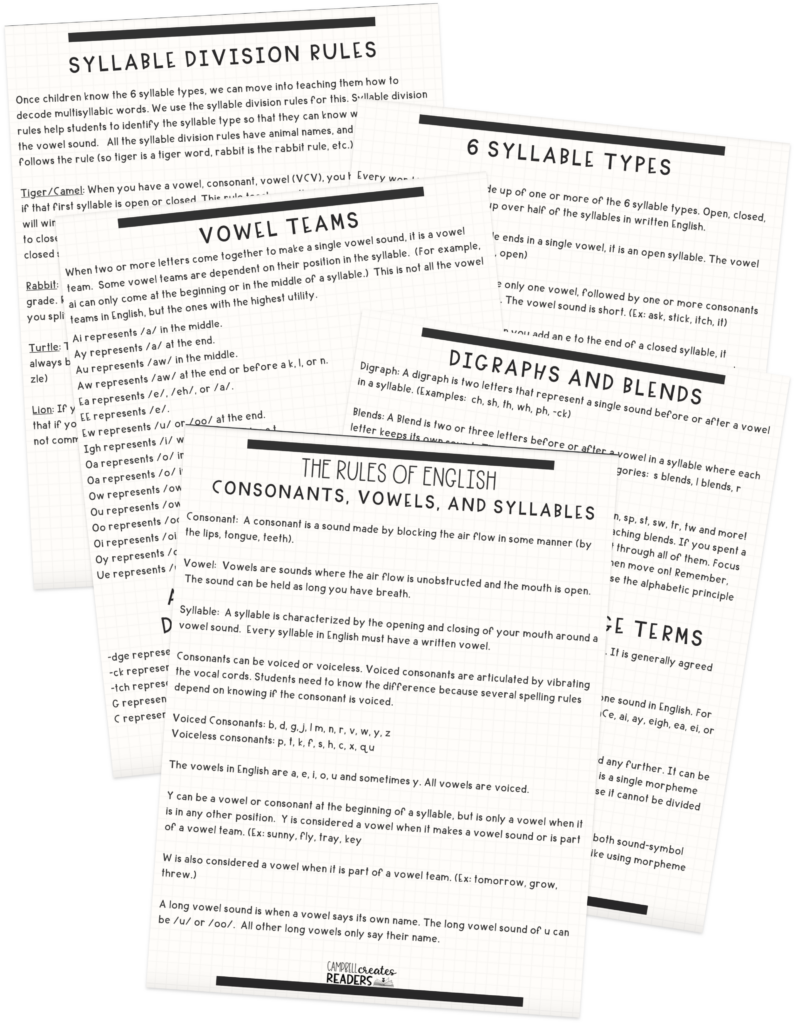
Feeling overwhelmed with all the terminology out there? Want to know the key terms all teachers need to teach phonics? In this FREE Rules of English cheat sheet, you get a 5 page pdf that takes you through the most important terms for understanding English—you’ll learn about digraphs, blends, syllable types, syllable divisions, and move. Grab today and take the stress out of your phonics prep!